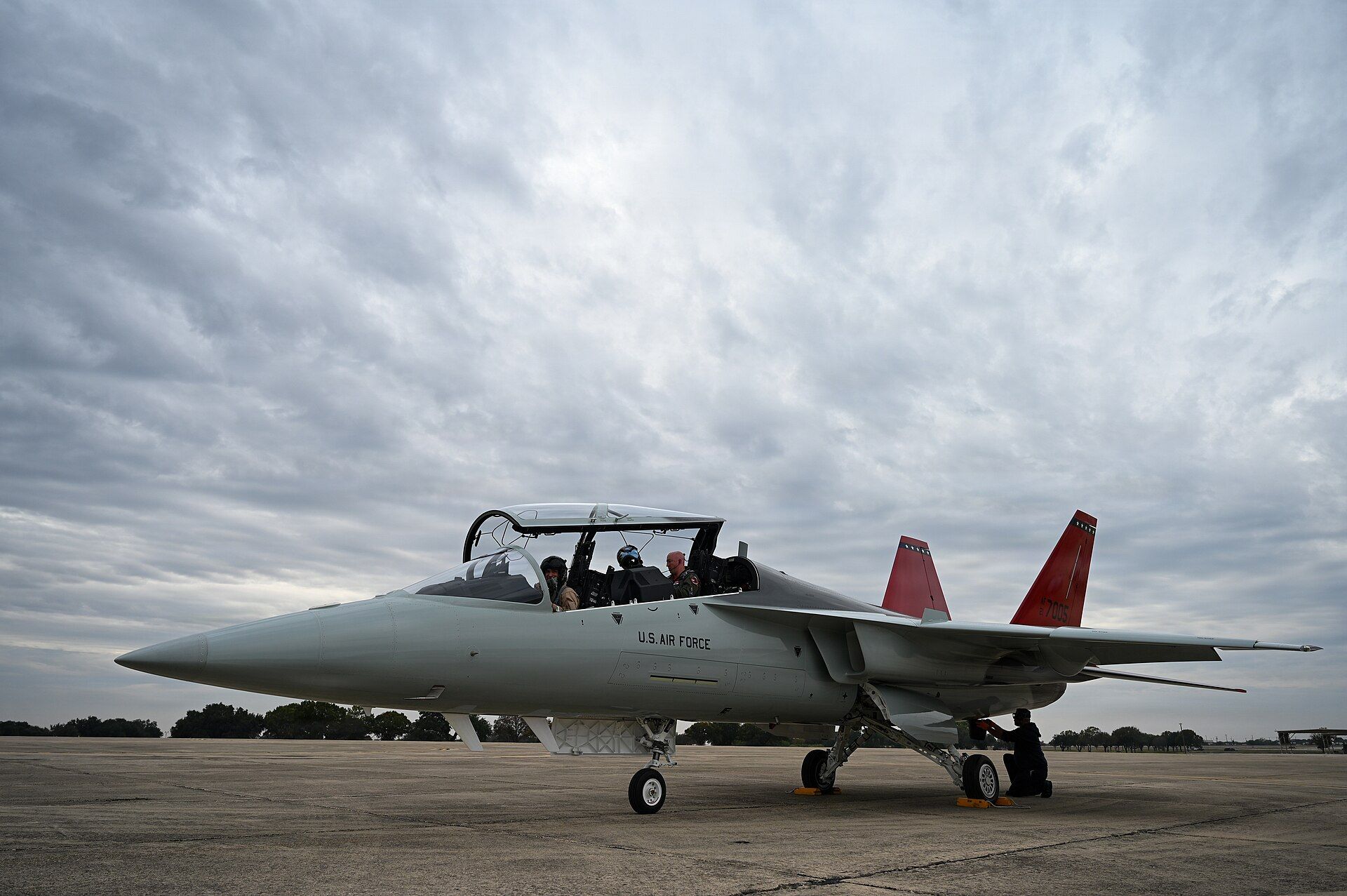
When Boeing and Saab rolled out the T-7A Red Hawk, the headline number was impossible to ignore: a clean-sheet jet trainer taken from initial design to first flight in roughly three years. For an industry accustomed to decade-long development cycles, that figure sounded less like an engineering milestone and more like a rebuke of the status quo. The T-7A, destined to replace the aging Northrop T-38 Talon as the U.S. Air Force's advanced pilot trainer, has since been held up as proof that digital engineering can compress timelines, cut costs, and rewrite the rules of military aircraft development. The question is whether that promise survives contact with reality.
The story begins with a genuine problem. The T-38 Talon has trained generations of fighter pilots since the early 1960s, but its margins have narrowed as modern fighters demand more from trainees. High-performance aircraft like the F-22 and F-35 require pilots comfortable with advanced avionics, high angle-of-attack handling, and glass-cockpit workflows long before they reach a frontline squadron. The T-38, a graceful but elderly design, struggles to bridge that gap. The Air Force's T-X program was conceived to find a replacement that could deliver those skills affordably and at scale.
Boeing's answer leaned heavily on model-based digital engineering. Rather than iterating through physical mockups and sequential design reviews, the team built and tested the aircraft almost entirely in a digital environment before committing to metal. Engineers used a common 3D model as the single source of truth, allowing design, manufacturing, and sustainment teams to work in parallel rather than in a slow relay. Saab contributed its own digital design expertise, and the partnership produced an aircraft with fewer parts, simpler assembly, and a modular architecture intended to keep sustainment costs down over decades of service.
The result was striking. Boeing went from contract award in 2018 to first flight of the first T-7A in late 2023, an unusually short span for a new military aircraft. The company has since pitched the approach as a template for future programs, arguing that digital threads, open mission systems, and rapid prototyping can deliver capability faster than the traditional acquisition model. That pitch has landed at a moment when the Pentagon is openly frustrated with the cost and schedule overruns of the F-35 Joint Strike Fighter, a program that has consumed enormous resources while drawing persistent criticism over sustainment expenses and software delays.
But the T-7A's development has not been frictionless. The program has encountered schedule slippage, including delays tied to ejection seat qualification and other technical issues, and the Air Force has adjusted its fielding timeline accordingly. Those setbacks matter because they illustrate a central tension: digital engineering can accelerate the early phases of a program, but it cannot eliminate the hard, physical work of certification, testing, and production ramp-up. A model can predict how a wing behaves; it cannot sign off on a parachute or a canopy jettison system. The T-7A's experience suggests that the most dramatic gains from digital design may be front-loaded, while the back end of a program remains stubbornly analog.
That nuance is important for how the industry interprets the T-7A's legacy. The aircraft is not a magic bullet that will end the F-35 era, nor is it a cautionary tale about digital engineering. It is better understood as a proof of concept with caveats. The program demonstrated that a smaller, focused team using modern tools can move faster than legacy processes allow, and it showed that open architecture and modularity can pay dividends in sustainment planning. At the same time, it revealed that acquisition reform is not a software problem. Budget cycles, congressional oversight, test infrastructure, and supplier capacity all impose their own timelines.
For Boeing, the T-7A carries strategic weight beyond the trainer market. The company's defense division has faced challenges on several fronts, and a successful, exportable trainer would provide a much-needed win. Several international customers have expressed interest in the platform, and its digital backbone could make it attractive to air forces seeking a bridge between basic trainers and fifth-generation fighters. For the broader industrial base, the T-7A offers a template that Airbus, Lockheed Martin, and others are already studying as they pitch their own digitally engineered concepts.
The outlook is mixed but instructive. The T-7A will not replace the F-35, and it was never meant to. What it can do is demonstrate that a disciplined digital approach, combined with realistic expectations about the physical phases of development, can produce capable aircraft faster and more affordably than the old model. If the program delivers on its remaining milestones, it will stand as a genuine inflection point. If it stumbles further, it will serve as a reminder that no amount of digital wizardry can outrun the fundamentals of flight testing and certification. Either way, the T-7A has already changed the conversation about how military aircraft should be built.
Comments (0)
No comments yet. Be the first to share your thoughts.